
How does a nuclear power station work?
How does a nuclear power station work?
A nuclear power station can be compared to a steam engine. It heats water, which is then turned into steam that drives a giant generator to produce electricity. However, unlike a steam engine, the water is heated using fissile materials, so there is no combustion and no CO₂ emissions.

In all nuclear power stations, electricity is generated through the fission of uranium or plutonium nuclei. When a fissile uranium or plutonium nucleus is struck by a neutron, it splits. This nuclear fission produces neutrons (two or three per fission) and creates new atoms (fission products such as xenon, krypton, iodine, caesium, etc.). This chain reaction releases large amounts of heat, which is used to heat water and turn it into steam. This steam then drives a turbine, to which an alternator is coupled, generating electricity.
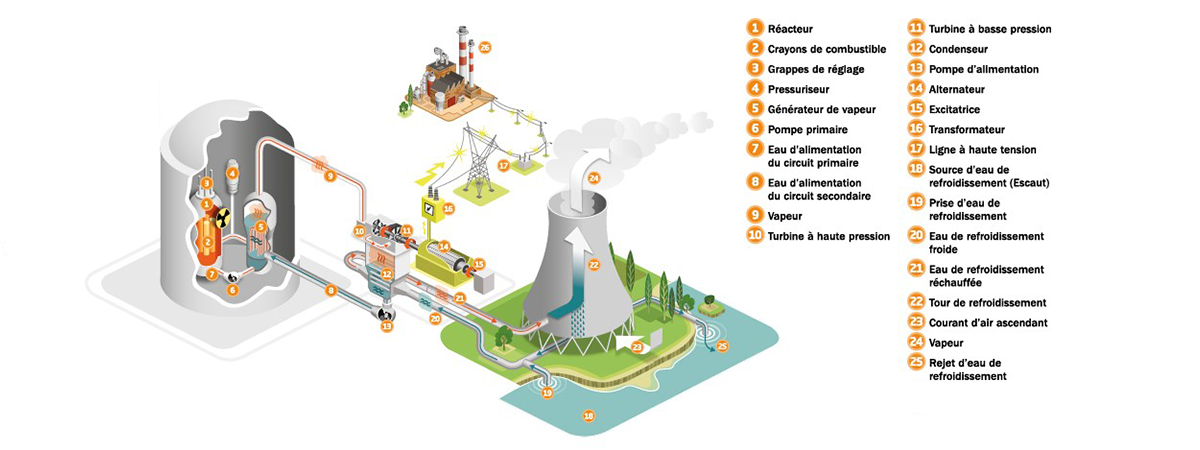
Pressurised water reactors (PWRs) such as those at Doel and Tihange
Electricity is generated in nuclear power stations via three water circuits that are completely independent of one another.
The primary circuit extracts the heat
The heat released by the controlled chain reaction taking place in the reactor vessel heats the water in the primary circuit. To prevent this water, which is at a temperature of around 300°C, from boiling, the pressuriser maintains it at a pressure of 155 bar.
In a steam generator, the water in the primary circuit transfers its heat to the water circulating in another closed circuit: the secondary circuit.
The secondary circuit produces steam
On contact with the tubes of the steam generators through which the water from the primary circuit flows, the water in the secondary circuit turns into steam. The pressure of this steam drives the turbine, which drives the alternator, which in turn generates electricity. The secondary cycle is also known as the ‘water–steam cycle’.
The tertiary circuit cools
This cooling circuit is essential for condensing the steam and removing residual heat. The steam from the turbine is converted back into water in a condenser, a huge heat exchanger containing thousands of tubes through which cold water drawn from an external source (a river or the sea) circulates. After passing through the condenser, the cooling water can be discharged in two ways. Either it is discharged, slightly warmed, back into the external source from which it originated. Or it releases its heat into the atmosphere via a cooling tower. Cooling towers ensure compliance with environmental regulations regarding the warming of watercourses.

The safety of a nuclear power station: five containment barriers
A series of five successive containment barriers completely isolates the uranium and the highly radioactive fission products.
Barriers 1 and 2: fuel pellets and fuel rods
The uranium is processed into ceramic fuel pellets (1), which are inserted into a protective metal cladding made of Zircaloy to form completely sealed fuel rods. The assembly of these rods forms the reactor core. The pellets are then stacked into sealed fuel assemblies (2).
Barrier 3: the reactor vessel
These rods are then assembled into fuel assemblies and placed in the reactor vessel (3), which has a steel wall 25 cm thick.
Barriers 4 and 5: the reactor building
A primary containment vessel prevents any release of radioactivity outside the reactor building (4); it withstands high internal pressure.
A second reinforced concrete containment structure (5) protects the facilities from external accidents. It is designed to cope with various incident or accident scenarios, such as a fire, a flood, an earthquake or an aircraft impact. A negative pressure difference between the two containment structures prevents any uncontrolled release of radioactivity to the outside.
