
Mutation breeding: developing more resilient plant varieties
Mutation breeding: developing more resilient plant varieties
Biodiversity is essential to life on Earth. In this context, nuclear technology is used in mutation breeding (mutagenesis) to develop plant varieties that are better adapted to environmental and climatic conditions.

Irradiation accelerates natural mutation
Genetic mutation (mutagenesis) occurs when plant seeds are exposed to irradiation. In just a few minutes, nuclear technology can create plant variants that would otherwise take thousands of years to emerge through the natural processes of mutation and adaptation. This technology helps address two major challenges of our time:
- Climate change is occurring so rapidly that many plants cannot adapt quickly enough to changing environmental conditions. Mutation breeding makes it possible to develop plant varieties better suited to a rapidly changing climate.
- The global population is growing rapidly. New plant varieties created through mutagenesis are not only more resistant to harsher climatic conditions, but can also, in some cases, produce more fruit or higher yields, helping to feed a growing population.
Through mutation breeding, nuclear technology creates valuable traits that may not occur naturally or may have disappeared during evolution. It produces crop varieties with higher, more stable yields and improved quality for both human and animal consumption. These varieties are better able to tolerate drought, soil salinity, and extreme temperature fluctuations, while also showing increased resistance to pests and diseases.
Nuclear technology underpins many techniques designed to improve crop productivity and quality while respecting both people and the environment.
Is it dangerous?
Quite the opposite! The irradiation of seeds in laboratory conditions does not leave any radioactive residue in the plants. It also eliminates harmful bacteria such as E. coli and Salmonella. Furthermore, irradiated crop varieties are less dependent on agrochemicals, which is an important factor in developing sustainable agriculture. These nuclear techniques have undergone rigorous safety assessments and help improve food safety while protecting the environment.
The International Atomic Energy Agency (IAEA) provides farmers in United Nations Member States with the techniques, training, and tools needed to produce these improved crop varieties. Its laboratories in Seibersdorf, Austria, have developed mutation-breeding techniques primarily for rice and wheat, but also for bananas and grapefruits. The Plant Breeding and Genetics Section also carries out plant irradiation and trains researchers who can subsequently improve agricultural productivity and food security in their home countries. Today, these improved crop varieties are cultivated around the world.
Is this genetic engineering?
No. Genetic engineering is a highly targeted process in which the structure of a plant's DNA is deliberately altered to achieve a specific modification in its traits, appearance, or properties. It focuses on changing a particular characteristic.
In mutation breeding, plant seeds are irradiated, generating genetic variants in much the same way that natural genetic variations occur spontaneously in nature, with only minor changes compared to the original plant. Naturally, this process is very slow. Mutagenesis does not introduce external DNA or directly alter a plant's genetic material. Instead, it stimulates natural variation. The resulting plant variants are then grown and evaluated in laboratory and field conditions. As the plants develop, researchers identify those exhibiting the most desirable characteristics. In other words, the process remains gradual and largely random, but it produces results much faster than spontaneous natural selection alone.
Examples
Namibia: crops better able to withstand drought
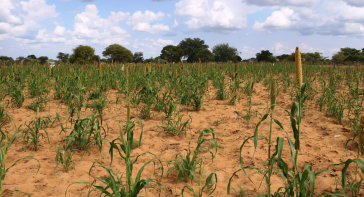
Agriculture is closely linked to Namibia’s growth and development. With its semi-arid and arid regions, Namibia is one of the driest countries in sub-Saharan Africa, making crop production particularly challenging.
The FAO (Food and Agriculture Organization of the United Nations) and the IAEA laboratories in Seibersdorf developed a support programme to improve drought tolerance in local crops. To create more resilient varieties, researchers exposed seeds of local crops to gamma radiation, including: cowpea (black-eyed pea), a highly nutritious legume, sorghum and pearl millet.
South America: fruit trees resistant to strong winds
In the Andean highlands, wind conditions can be extreme. A very localized phenomenon occurs there: wind speeds are significantly stronger at around 1.5 metres above the ground than at 50 centimetres. For fruit-bearing trees, this difference can be crucial. Because of strong winds in the Andes, some traditional apple trees, which bear fruit beginning around 1.2 metres above the ground, can lose much of their crop before harvest. By developing apple tree varieties that produce fruit closer to the ground, for example from about 50 centimetres in height, the impact of the wind is reduced. As a result, the trees can retain more fruit and achieve higher yields.